

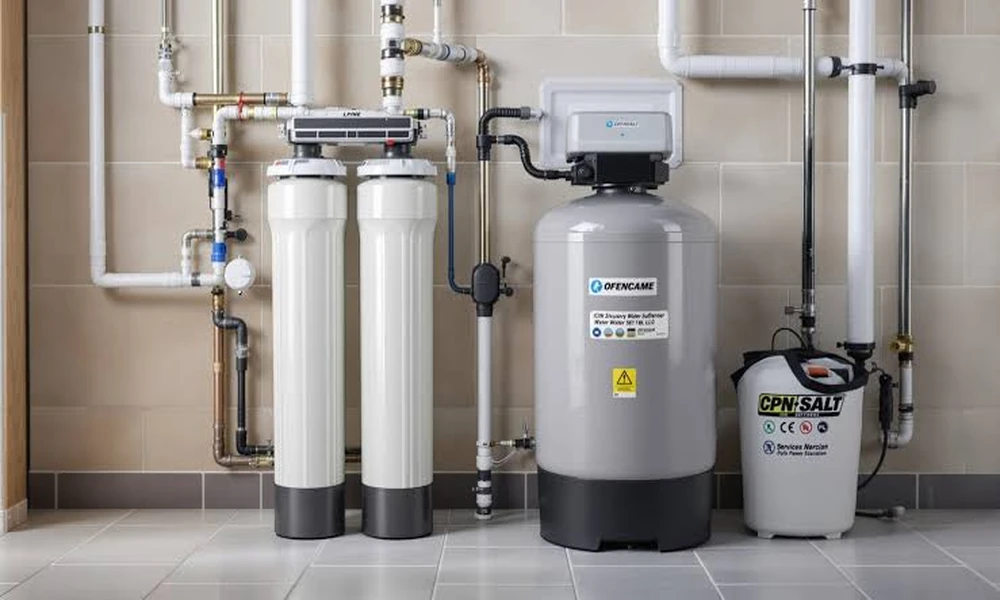
Most water softeners spend their lives in a garage corner or a utility closet, next to the water heater, where nobody looks at them until the shower starts feeling different. They’re blue or beige tanks with a timer head on top and a brine tank beside them, and the owner usually knows only that salt goes in. That is a shame. A softener that was sized well and set up properly can protect every pipe and appliance in the house for more than a decade. One that was guessed at wastes salt, lets hard water through, and slowly wears itself out.
Across much of central Texas, tap water comes from aquifers and rivers that move through limestone. On the way, it dissolves calcium and magnesium, which show up as white crust on faucet aerators, cloudy spots on dishes, and scale inside tank water heaters. Homeowners in this kind of water country who want a second opinion before they buy often call Garrett’s Plumbing. The family business has spent 27 years and four generations repairing and installing water softeners along with water heaters, leak detection and repiping work, so they see what hard water has done to a house’s plumbing as well as what the softener is meant to stop.
Before any of that makes sense, it helps to understand what the softener is actually fighting.
Reading the Number on Your Water Report
Hardness gets reported in two ways, and the mix-up causes many bad purchases. Utilities usually list it in parts per million (ppm) or milligrams per liter, and those two units are the same thing. Softener makers talk in grains per gallon. To convert, divide the ppm figure by about 17.1. A report showing 170 ppm works out to roughly 10 grains per gallon, which is solidly hard water.
If you’re on a private well, don’t trust a neighbor’s number. Two wells a mile apart can differ a lot, and wells often carry some iron too, which changes the sizing math. A lab test costs little next to a softener that turns out to be the wrong size.
Doing the Capacity Math Before You Shop
Softeners are rated by how many grains of hardness they can remove before they need to recharge. A standard planning figure is about 75 gallons of water per person per day. A family of four therefore uses around 300 gallons a day, and at 10 grains per gallon that comes to 3,000 grains of hardness removed every day.
Most installers aim for a recharge about once a week, which here means roughly 21,000 grains between cycles. On paper that suggests a 24,000-grain unit, but paper capacity assumes the heaviest salt setting. A softener running at an efficient salt dose delivers less than its label, so a 32,000-grain model set to a moderate salt level often ends up being the better buy. It uses less salt per cycle, and its resin works less hard.
Iron complicates things. The usual rule adds several grains of compensated hardness for every part per million of iron, because iron fouls the resin and wears down capacity faster than calcium does.
Oversizing causes problems of its own. A unit that is far too big may go so long between cycles that the resin bed sits, channels and loses efficiency. It’s a reminder that bigger isn’t automatically better.
What Happens During One Regeneration
The process inside the tank explains most service calls later on. Resin beads hold sodium ions loosely, and as hard water passes over them, calcium and magnesium take the sodium’s place. When the beads are full, the control valve runs a recharge in stages:
- Backwash. Water flows upward through the resin to lift and loosen the bed and flush out sediment.
- Brine draw. Salty water is pulled from the brine tank and passed slowly over the beads, forcing the hardness minerals off.
- Slow rinse. The brine is pushed through and out to the drain along with the released minerals.
- Fast rinse. A quicker flow packs the bed back down and clears out any leftover salt taste.
- Refill. Fresh water goes back into the brine tank so it can dissolve salt for the next cycle.
Modern demand-initiated valves count the gallons that have passed through and recharge only when the household has actually used up the capacity. The older timer models recharge on a fixed schedule whether the family has been away for a week or has had guests staying.
Salt, Potassium and the Sodium Question
Plain sodium chloride pellets are the standard fuel, and high-purity pellets leave less residue than rock salt. Potassium chloride is the other common choice for people who want to cut sodium. According to extension guidance from North Dakota State University, potassium costs considerably more, needs about 10 percent more product, and holds onto the resin more tightly, which makes the softener somewhat less efficient.
The same source puts added sodium at roughly 8 milligrams per liter for every grain of hardness removed. For most people that is a modest amount. For anyone on a sodium-restricted diet, a common fix is to leave the kitchen cold tap unsoftened, or to add a small reverse osmosis unit under the sink just for drinking and cooking water.
When the Brine Tank Stops Doing Its Job
Two salt problems account for a lot of “my softener quit” complaints. A salt bridge forms when humidity fuses the pellets into a hard crust with an empty gap underneath. The tank looks full, but the water below never touches salt, so the resin regenerates with plain water and hard water comes through the taps. Pressing down on the crust with a broom handle usually breaks it up.
Mushing is messier. Low-quality salt dissolves and then recrystallizes into a sludge at the bottom of the tank, which can clog the brine line. Fixing it usually means draining the tank and scooping it out.
Beyond salt, the brine float, the injector screen and the drain line all wear over time. Resin generally lasts somewhere between ten and fifteen years, but chlorine and chloramine in city water break the beads down faster. If the water starts feeling hard again even though the salt level is fine, tired resin is often the cause, and replacing the resin costs far less than a new system.
Conditioners and Filters, and What They Can’t Do
Salt-free “conditioners” deserve a straight explanation. Most of them use template-assisted crystallization, which turns hardness into tiny crystals that stick to surfaces less readily. That can reduce scale inside a water heater. It doesn’t remove the minerals, though, so spotted glassware and that squeaky, hard-water feel on the skin stay. Magnetic clamp-on devices have even weaker evidence behind them. Whole-house sediment filters protect the softener valve but do nothing about hardness. Each of these has a place, but none of them replaces ion exchange when the water is truly hard.
Where Soft Water Pays You Back
The payback is clearest inside a water heater. Scale settling on the bottom of a gas tank insulates the water from the burner, so the unit runs longer and you hear rumbling and popping as trapped water flashes to steam. Tankless heaters scale up inside their narrow heat exchangers and need regular descaling in hard-water homes. Softened water slows both problems a great deal, and it also extends the life of faucet cartridges, toilet fill valves and dishwasher spray arms.
Placement matters as much as the unit you pick. A good installation puts the softener after the hose bibs so lawn water isn’t softened for nothing, adds a bypass valve so it can be serviced without shutting off the house, and runs the drain line with a proper air gap so wastewater can never siphon back into the supply. Many newer homes in the region have a softener loop built into the garage wall, which makes the job far simpler than cutting into the main line.
Look after it with decent salt, the occasional check for bridging and a sensible capacity setting, and a softener will keep limestone water from slowly wearing down the rest of the house for many years.
