

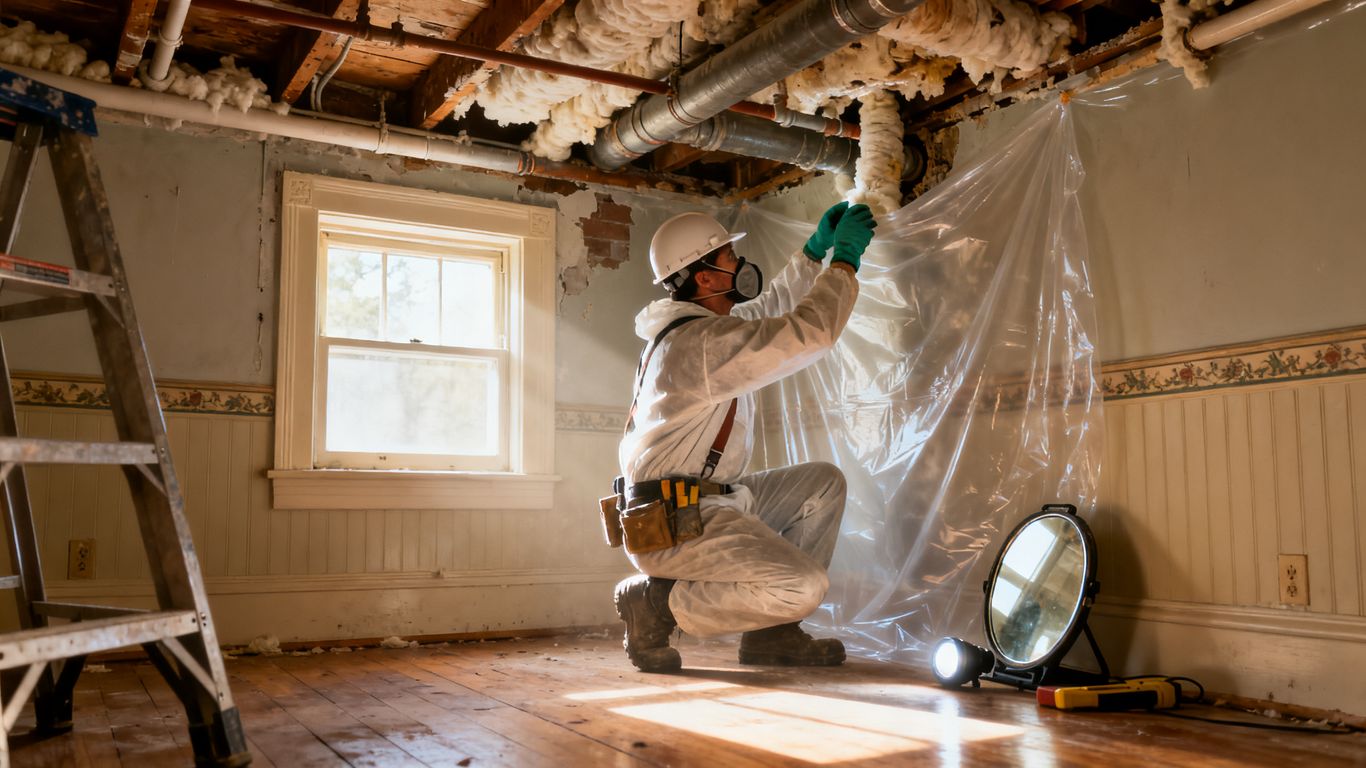
Asbestos was valued in construction because its fibers could add heat resistance, durability, and insulation to building materials. For that reason, it appeared in many homes built or remodeled before modern restrictions reduced its use. Age alone cannot confirm that a material contains asbestos, but it is a useful reason to pause before opening walls, removing flooring, or disturbing ceilings. A practical overview of asbestos in older homes can help homeowners understand where the concern begins.
Common asbestos-containing materials in houses
Asbestos may be present in insulation, floor tiles, flooring adhesive, pipe wrapping, cement products, roofing materials, siding, textured ceiling coatings, and some joint compounds. It was also incorporated into materials designed to resist heat or fire, including components around furnaces, boilers, and ducts. The material may be mixed into a product rather than visible as loose fibers, which makes casual identification unreliable. A house can contain asbestos even when its surfaces look ordinary and well maintained.
Where asbestos is often found during renovations
Renovation exposes areas that everyday living leaves untouched. Flooring removal may reveal old tile or adhesive, while demolition around a boiler can disturb insulation or pipe covering. Ceiling work, electrical upgrades, window replacement, and repairs to walls or siding can also bring older materials into question. Because asbestos can occur in several parts of one building, a renovation assessment should consider the entire work area rather than only the surface scheduled for removal.
Why intact materials may pose less immediate risk
Asbestos-containing material generally presents less immediate exposure risk when it remains intact, firmly bound, and undisturbed. That does not make it harmless or suitable for casual handling; it means the fibers are less likely to enter the air under those conditions. Damage from water, age, vibration, or previous repairs can change the situation. Leaving a sound material alone may sometimes be safer than removing it, but the appropriate decision depends on its condition and the planned work.
How renovation work can disturb hidden asbestos
A wall or ceiling can conceal materials that are not apparent during a quick walkthrough. Drilling, cutting, sanding, scraping, breaking, or pulling apart layered construction can release fibers if asbestos is present. Even a small repair can affect a larger connected system, such as insulation running behind a wall or adhesive beneath several rooms of flooring. That is why the safest renovation plan addresses suspect materials before demolition begins, not after dust has already spread.
Understanding asbestos renovation risks
Asbestos renovation risks depend less on the label of a project than on what the work does to the material. A quiet room with intact materials is different from a demolition zone filled with dust and debris. Exposure can be brief or repeated, localized or spread through a home, and obvious or unnoticed. Careful planning reduces the chance that a routine improvement becomes an uncontrolled disturbance.
How fibers become airborne
Asbestos fibers can become airborne when a material containing them is broken, abraded, cut, drilled, sanded, scraped, or otherwise disturbed. Once suspended, microscopic fibers may be inhaled and can travel beyond the point where the original work occurred. Dry sweeping or ordinary cleanup can redistribute settled dust rather than remove it safely. The absence of visible dust is not proof that no fibers were released.
Activities that increase exposure risk
Some renovation tasks are particularly likely to disturb suspect materials because they use friction, impact, or force. The following examples explain why a pre-work assessment matters:
- Removing old floor tiles or scraping their adhesive
- Sanding textured ceilings, joint compound, or painted surfaces
- Cutting into insulation, pipe wrapping, siding, or cement products
- Breaking walls, ceilings, ducts, or other layered building materials
These tasks do not prove that exposure has occurred, but they can create conditions in which fibers are released if asbestos is present. Work should be paused until the material has been assessed and the appropriate controls are established.
Why DIY demolition can be especially hazardous
DIY demolition often begins before anyone has identified what is behind a surface. Homeowners may use power tools, tear out several materials at once, or move debris through occupied rooms, creating multiple opportunities for dust to spread. Household vacuums, fans, and open windows are not substitutes for regulated containment and specialized cleanup. A DIY asbestos renovation guide provides a useful reminder that family members can be affected even when they are not the people doing the work.
Factors that affect the level and duration of exposure
The potential impact of an exposure depends on factors such as the type and condition of the material, how much was disturbed, the concentration of fibers in the air, the duration and frequency of work, and the effectiveness of containment. Personal circumstances, including smoking history and existing lung conditions, also matter when health risks are considered. A single exposure cannot be translated into a precise future outcome from appearance alone. Professional assessment and medical context are both more useful than guesswork.
What asbestos exposure can do to your health
Asbestos-related disease usually develops after inhaled fibers remain in the body and cause injury over time. The possible consequences include scarring disorders and cancers, but risk varies among individuals and exposures. A person who is worried after renovation should avoid assuming either that illness is inevitable or that a lack of symptoms proves everything is fine. The health discussion is serious, while still requiring individualized medical advice.
How asbestos fibers affect the lungs
When inhaled, asbestos fibers can lodge in the airways or deeper lung tissue. The body may respond with persistent inflammation and scarring, which can reduce the lungs’ ability to function normally. Some fibers can also affect the thin lining around the lungs. The nature and severity of disease depend on the exposure and on individual factors, and not every exposed person develops a recognizable illness.
The link between asbestos and lung cancer
Asbestos exposure is associated with an increased risk of lung cancer. That risk is especially significant when combined with cigarette smoking, although asbestos can contribute to lung cancer in people who do not smoke. Symptoms such as a persistent cough, chest discomfort, or shortness of breath have many possible causes and should not be self-diagnosed. Medical evaluation is appropriate when symptoms persist or when a clinician believes a history of exposure is relevant.
Other asbestos-related diseases, including mesothelioma
Asbestosis is a form of lung scarring associated with substantial or repeated exposure. Asbestos can also contribute to pleural changes, including thickening or plaques, and to mesothelioma, a rare cancer affecting the lining of the chest or other body cavities. Mesothelioma is distinct from ordinary lung cancer, even though both may involve the respiratory system. Readers seeking a broader explanation of asbestos-related health effects can use that information as background, not as a personal diagnosis.
Why symptoms may take decades to appear
Asbestos-related diseases often have long latency periods, meaning symptoms may not appear until many years after exposure. The delay can make it difficult to connect a current health problem with renovation work that happened long ago. It also explains why feeling well immediately after a project does not settle the question of future risk. A documented exposure history remains worth recording even when no immediate symptoms are present.
How to identify possible asbestos before work begins
The safest time to address asbestos is before materials are disturbed. Homeowners do not need to identify every suspect product themselves, but they should recognize when a project warrants professional evaluation. Building age, renovation history, material condition, and the planned scope of work all help determine the next step. Testing is the way to confirm a suspicion; appearance alone is not.
Why visual inspection is not enough
Many asbestos-containing materials resemble ordinary flooring, plaster, insulation, cement, or adhesive. Some contain only a small percentage of asbestos fibers, so the material may look completely unremarkable. Color, texture, and age can suggest a possibility but cannot establish what is present. Scraping or breaking a sample to get a closer look may create the very disturbance a homeowner is trying to avoid.
When an asbestos inspection is recommended
An inspection is prudent before renovation in an older home when the work may disturb insulation, flooring, ceilings, walls, siding, roofing, ducts, or other original materials. It is also sensible when previous remodeling has created uncertain layers or when damage has exposed unknown material. Local rules may impose additional requirements, especially for larger projects or work in multifamily buildings. A qualified professional can define the areas that need assessment and explain what must happen before work resumes.
How qualified professionals collect and test samples
A qualified asbestos professional evaluates the work area and takes representative samples using procedures intended to limit fiber release. Samples are then submitted for laboratory analysis, and the results are interpreted alongside the material’s condition and the renovation plan. Sampling should not be improvised with household tools or performed by someone who lacks the required training. Until results are available, suspect materials should be treated cautiously rather than presumed safe.
Materials that should not be disturbed while awaiting results
While awaiting results, workers should avoid drilling, sanding, cutting, scraping, sweeping, or removing the suspect material. Furniture and tools should not be dragged through the area, and loose debris should not be handled casually. If the material is damaged, the area should be managed according to professional advice rather than cleaned by ordinary methods. The goal is to preserve the situation for safe evaluation and prevent additional dust from entering occupied spaces.
What to do if you discover asbestos during renovation
Finding suspect material halfway through a project can be unsettling, but the immediate response should be controlled and simple. Work should stop before anyone tries to identify, move, or clean the material. People should leave the area without tracking debris through the home, and the next call should be to a qualified asbestos professional or the appropriate local authority. A practical renovation discovery checklist reinforces these first priorities.
Immediate steps to limit further exposure
Workers should stop the task that disturbed the material and avoid touching it further. They should keep others out of the area, limit movement that could spread dust, and contact a qualified inspector or contractor for direction. Clothing, tools, and debris that may be contaminated should not be carried through clean areas without professional guidance. Calm, deliberate action is more protective than hurried cleanup.
When to stop work and keep people away
Work should stop whenever an unknown material is damaged or disturbed and asbestos is reasonably possible. The area should be kept away from children, pets, residents, and nonessential workers until it has been assessed. Doors or other boundaries may be managed to restrict access, but people should not improvise containment techniques that disturb the material further. If dust has spread, the affected area should be described to the professional who responds.
Why wetting, covering, or removing materials incorrectly can increase risk
Moisture can reduce dust under some controlled procedures, but randomly spraying a material does not make it safe to handle. Covering, taping, scraping, or removing it without understanding its condition can break surfaces or spread contamination. Ordinary vacuuming and sweeping may also move fibers into the air or across adjacent rooms. Avoiding improvised cleanup is a central safety measure until trained personnel determine what controls are needed.
How licensed asbestos contractors handle abatement and disposal
Licensed or otherwise properly qualified asbestos contractors assess the material, establish containment and work practices, use appropriate protective equipment, and follow applicable disposal requirements. The exact process depends on the material, its condition, the size of the project, and local regulations. After the work, clearance or other verification may be required before an area is returned to normal use. Homeowners should ask which credentials, procedures, and documentation apply in their jurisdiction.
Reducing exposure for household members and workers
Renovation safety extends beyond the person holding the tool. Fibers can be carried on clothing, footwear, equipment, or debris if a work area is not properly controlled. Household members may be exposed without ever entering the room where the material was disturbed. Separating the work from daily life, and following professional instructions consistently, helps reduce that secondary pathway.
Keeping children, pets, and other residents away from the work area
Children and pets should not enter a renovation area containing suspect or confirmed asbestos materials. Residents should also avoid passing through the space to retrieve belongings or inspect progress. Their smaller bodies, frequent floor contact, and tendency to touch surfaces make casual access particularly undesirable, though every resident deserves protection. Temporary relocation may be appropriate when containment cannot separate the work from the living space.
Preventing fibers from spreading through the home
Doors, ventilation pathways, footwear, clothing, tools, and debris can all connect a work zone to clean rooms. People should follow the contractor’s instructions about access, changing clothes, cleaning, and movement between areas. Fans that push air from the work zone into the home can worsen spread, as can carrying uncovered waste through hallways. Cleanup should be performed with methods designed for asbestos work, not by ordinary household routines.
Protective equipment and why it does not replace professional controls
Respiratory protection and disposable clothing can be part of a trained worker’s control program, but equipment alone does not prevent fibers from escaping a work area. Fit, training, maintenance, decontamination, and disposal all affect whether protective equipment works as intended. An untrained homeowner wearing a mask may still create exposure through poor containment or contaminated clothing. Engineering controls, work practices, and regulated procedures come first.
Special considerations for neighbors and workers on shared properties
In attached housing, multifamily buildings, or properties close to one another, renovation dust may affect people outside the immediate household. Building managers and contractors may need to coordinate access, ventilation, waste movement, and notifications under local requirements. Shared walls and common mechanical systems deserve particular attention. Neighbors should be told whom to contact with concerns, while technical decisions remain with qualified professionals.
Medical care and long-term monitoring after possible exposure
A possible renovation exposure does not automatically mean that disease will develop, but it should be documented thoughtfully. Medical decisions depend on the nature of the event, symptoms, smoking history, overall health, and applicable screening guidance. A healthcare professional can help distinguish an exposure concern from a current illness and decide whether follow-up is warranted. This is a situation where clear information is more useful than panic.
When to discuss an exposure with a healthcare professional
A person should discuss a suspected exposure with a healthcare professional if the material was disturbed, if substantial dust was present, if exposure was repeated, or if respiratory symptoms develop or persist. Prompt care is appropriate for significant breathing difficulty, chest pain, or other urgent symptoms. Even when the event seemed brief, a clinician may recommend documenting it for future reference. The medical conversation should focus on facts rather than attempting to estimate risk from a single online description.
What information to bring to a medical appointment
Useful information includes the home’s approximate age, the renovation dates, the material involved, the tasks performed, visible dust or debris, the length and frequency of exposure, and whether anyone smoked. Inspection reports, laboratory results, contractor records, photographs, and details about protective measures can add context. The names of other potentially exposed household members should also be recorded separately. Good documentation may help a clinician make a more informed recommendation years later.
How smoking can compound asbestos-related lung cancer risk
Smoking and asbestos exposure can work together to raise lung cancer risk more than either factor considered alone. A smoking history therefore matters even if the asbestos exposure occurred during only one renovation. Stopping smoking remains one of the most meaningful steps a person can take to improve respiratory health, and healthcare professionals can offer cessation support. Smoking cessation does not erase past exposure, but it can change the broader risk picture.
Why routine screening decisions should be individualized
There is no single screening schedule that fits every person who may have encountered asbestos. Clinicians consider age, smoking history, cumulative exposure, symptoms, other illnesses, and current screening recommendations before suggesting imaging or specialist referral. Unnecessary testing can create its own problems, while ignoring persistent symptoms is unwise. Long-term follow-up should therefore be discussed with a healthcare professional who knows the individual’s history and can reassess it over time.
